
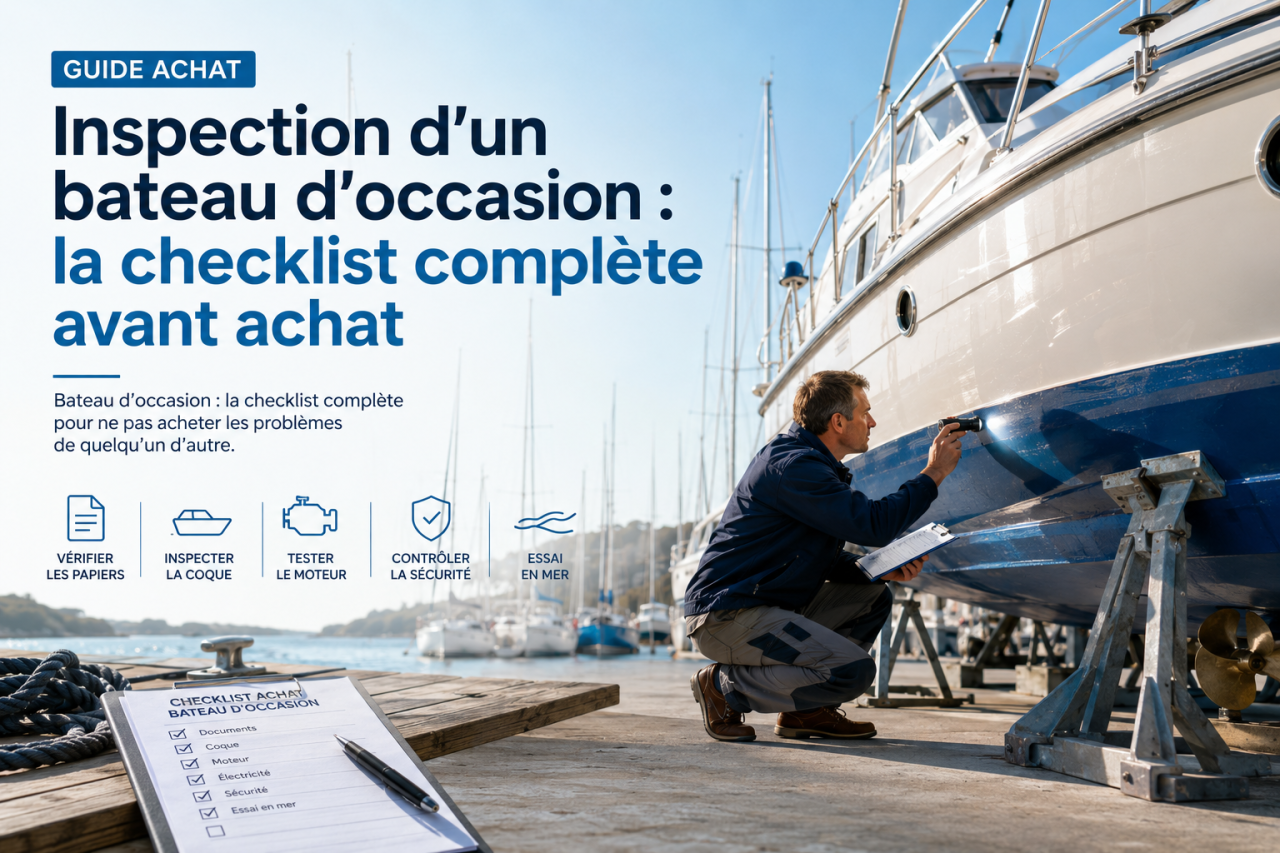
Used Boat Inspection: The Complete Checklist Before Buying
BUYING GUIDE
Used boat: the complete checklist to avoid buying someone else’s problems.
Buying a used boat is often one of the best decisions you can make. It is also a transaction that deserves to be approached methodically, regardless of the budget. A thorough inspection before signing protects the buyer from unpleasant surprises and enhances the seller’s credibility: a boat with complete documentation and traceable maintenance records sells better, faster, and without disputes.
1. Before the Visit: Documents to Request from the Seller
The first inspection begins from home, before you even travel to see the boat. Requesting the documents in advance allows you to immediately detect inconsistencies in the ownership history or any administrative issues that could block the sale.
- The navigation title — registration deed or registration certificate — must be in the seller’s name and match the boat details: brand, model, HIN number, and dimensions.
- Purchase and maintenance invoices: engine logbook, oil changes, impeller replacement, anodes, belts, and sterndrive servicing.
- Claims history: insurance certificate and, if possible, a record of previous claims.
- A certificate confirming the absence of a maritime mortgage for boats subject to French registration requirements.
- CE compliance certification showing category A, B, C, or D, as well as the owner’s manual if available.
2. Exterior Inspection: Hull, Deck and Deck Hardware
Whenever possible, inspect the boat while it is out of the water, on land or in a shipyard. This is the only way to properly examine the underwater section of the hull.
The Hull
- Look for blisters or bubbles in the gelcoat: they may indicate osmosis.
- Tap suspicious areas with a plastic hammer: a dull sound may reveal delamination.
- Check the hull-to-deck joint, transom, bow, keel attachment and the condition of the structural frames.
The Deck and Superstructures
- Walk everywhere on deck: a soft area underfoot often indicates water intrusion into the deck sandwich structure.
- Check for leaks around portholes, fairleads, cleats and toe rails.
Deck Hardware and Safety Equipment
- Cleats, stanchions and pulpits must be firmly secured.
- Test the windlass: it should raise and lower smoothly without jerking.
- Check the presence and condition of all mandatory safety equipment.
3. For Sailboats: Rigging and Sails
The rigging represents a significant expense if replacement is required. A broken shroud at sea can have serious consequences: this inspection should never be overlooked.
- Standing rigging: check shrouds, turnbuckles, chainplates and forestay. The age of the rigging should be known; replacement is generally recommended every 10 to 15 years.
- Running rigging: inspect halyards, sheets, reefing lines and the rotation of pulleys and blocks.
- Mast and boom: look for impacts, cracks, corrosion and alignment issues.
- Sails: inspect stitching, bolt ropes, reef bands and the UV protection strip on the genoa.
4. Engine and Propulsion: The Most Critical Inspection Point
The engine often represents a significant portion of the value of a used motorboat. It is also the area where a professional survey is most often worth the investment.
- General condition: no old oil deposits, fuel traces or advanced corrosion.
- Wiring and hoses: they should remain flexible, clean and properly secured.
- Engine maintenance: engine hours should be consistent with the age of the boat and the available invoices.
- Cold start test: observe smoke, noise, idle quality, vibrations and throttle response.
- Lower unit, propeller and transmissions: inspect for impacts, bellows condition, anodes and abnormal play.
5. Electrical System, Gas, Plumbing and Interior
These systems are often overlooked during a quick inspection. However, they deserve special attention, both for safety reasons and because repair costs can quickly become significant.
- Electrical system: clean control panel, labelled cables, no loose wires or exposed connector blocks.
- Batteries: check their age, mounting security and the absence of oxidation on the terminals.
- Gas system: hoses should be dated, within validity limits, flexible and free from cracks.
- Fresh water and grey water systems: inspect tanks, pumps, water heater and check for leaks.
The Bilge, Interior Fittings and Water Intrusion
- The bilge: it should be clean, dry, free from oily residue and without any fuel smell.
- Interior fittings: woodwork, bulkheads and flooring should feel solid and stable.
- Signs of water intrusion: look for stains, mould, marked upholstery or damp odours.
6. Sea Trial: The Decisive Step
A dockside inspection can create the illusion of a boat in good condition. A sea trial reveals the true behaviour and performance of the boat under load.
- Test the engine at different RPM ranges.
- Observe temperature, vibrations, acceleration and deceleration.
- Check the autopilot and navigation instruments.
- For sailboats, test manoeuvres and helm responsiveness.
- Verify that the HIN numbers and builder’s plate match the official documents.
Should You Hire a Professional Surveyor?
The short answer is yes — as soon as the financial stakes justify it, which is often the case.
An independent marine surveyor performs a thorough inspection: hull sounding, electronic testing of onboard systems, engine analysis and the preparation of a detailed report. Compared to the value of a purchase worth several tens of thousands of euros, it is a reasonable investment.
At Mahé Nautic, our purchase support service includes precisely this professional expertise: an experienced eye shaped by more than 600 transactions, capable of detecting what an untrained eye may miss and ensuring complete peace of mind throughout the buying process.
Sources and References
- Sea Riders — Inspecting a Used Boat: 50-Point Checklist
- APRIL Marine — Key Points to Check Before Buying a Boat
- Voile et Moteur — Used Sailboat: Key Inspection Points
- Mers et Bateaux — Guide to Inspecting a Used Motorboat
- Nautica Shop — Checklist for Buying a Used Boat
- EspacePower — Documents to Check Before Buying a Used Boat
- French Transport Code — Boat Registration and French Flag Certification
Glossary of Technical Terms
| Term | Definition |
|---|---|
| French Registration Certificate | Official document certifying that the boat sails under the French flag. |
| Sacrificial Anode | Metal component designed to corrode first in order to protect submerged parts. |
| Chainplate | Metal fitting used to anchor the shrouds to the hull or deck. |
| Haul-Out | Removing the boat from the water to clean, service and inspect the hull. |
| Delamination | Separation between layers of composite material in the hull structure. |
| HIN | Hull Identification Number, generally visible on the transom. |
| Impeller | Water pump turbine responsible for engine cooling. |
| Osmosis | Polyester degradation causing blisters beneath the gelcoat. |
| Through-Hull Fitting | Hull penetration allowing the passage of water pipes or systems. |
| Floor Timber | Internal structural frame providing rigidity to the hull. |
Looking for a used boat in Brittany or wishing to sell your own? Contact us by email at [email protected] or by phone at 06 59 84 61 73.